What Oral Semaglutide Really Costs in 2026 (And What That Number Is Actually Paying For)

Here’s the thing nobody tells you when a new drug gets approved: the price list explodes before the guidance does. Oral semaglutide just became two real, FDA-approved medicines instead of one, and that means a wave of new prices, new sellers, and new ways to get confused about what you’re actually buying. This piece walks through that confusion the way a friend would if they’d spent a weekend reading the trial data for you.
First, the news part, because the timing matters. Rybelsus, the once-daily diabetes tablet, has been around since September 2019, and in October 2025 the FDA widened its job description: it can now also reduce the risk of major cardiovascular events in adults with type 2 diabetes and established heart disease [3][5][8]. Then, on December 22, 2025, the FDA approved something new entirely: a once-daily oral semaglutide 25 mg tablet under the Wegovy name, for chronic weight management, the first oral GLP-1 pill ever approved for obesity, with a US launch expected in early January 2026 [1][2]. Two approved drugs. A flood of price points. And a flood of price points is exactly the moment people start mistaking “cheapest” for “best deal.”
The worry: is the lowest price ever actually the best one?
Almost never, and it’s worth sitting with why. The cheapest thing calling itself “semaglutide” online is nearly always gray-market powder sold as a research chemical, no prescription, no clinician, no pharmacy. It looks unbeatable because it has quietly removed everything that costs money, which happens to be everything that makes the drug safe and worth taking in the first place.
The genuine tablets, both Rybelsus and the oral Wegovy pill, are brand-name prescription drugs made by Novo Nordisk, moving through one accountable supply chain and out through licensed pharmacies on a real prescription [1][3]. They’re built around a specific engineering trick: semaglutide paired with an absorption enhancer called SNAC (sodium N-(8-(2-hydroxybenzoyl)amino)caprylate), which briefly shields the peptide long enough for a fraction of it to survive the stomach [3][4]. That formulation isn’t a bonus feature bolted onto the price. It’s the product.
A vial of loose powder has none of that. No verified identity or purity, no engineered absorption system, no clinician managing the dose as it climbs, and nobody watching for the thyroid and gastrointestinal cautions printed right on the real label [1][3]. Sellers hide behind a “research use only” sticker so they never have to answer for the gap between what you thought you bought and what actually showed up. Cheapest sticker, worst deal, because the value was in the parts that got cut.
So the useful question isn’t “what’s the lowest price for semaglutide.” It’s “what’s the lowest price for legitimately sourced, supervised semaglutide that I’ll actually take correctly, long enough to feel it work.” That’s a completely different comparison, and it’s the one that should shape any ranking.
The answer: what your money is buying, and what it’s worth
There are really two purchases hiding inside every semaglutide price tag, and people conflate them constantly.
One is the medication itself, the manufacturer’s tablet, exact and specific. The other is supervision: a licensed clinician, a managed dose titration schedule, coaching on how to actually take the pill, and months of follow-up. This second piece is the one people underprice, and it’s the piece that decides whether the first piece does anything for you. A drug taken correctly for months is worth more than the same drug abandoned in week three because the dose ramped up too fast, or because every tablet got swallowed with breakfast coffee and never had a chance to absorb.
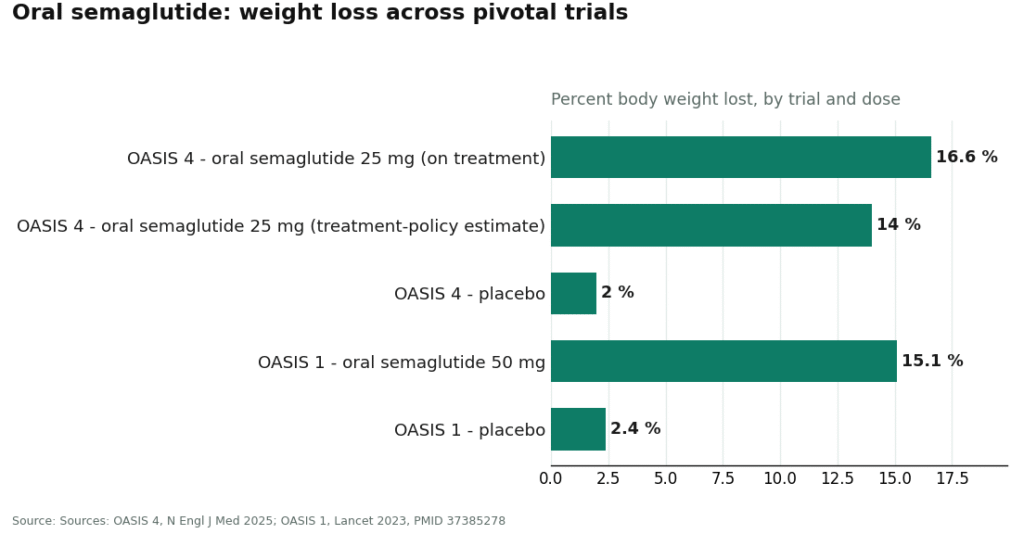
Here’s why that follow-up is worth paying for. In the pivotal OASIS 4 trial, 307 adults with obesity or overweight and no diabetes were randomized, 2 to 1, to once-daily oral semaglutide 25 mg or placebo, alongside lifestyle changes, over roughly 64 weeks. Among people who stayed on treatment, mean weight loss ran about 16.6%, with roughly one in three losing 20% or more of their body weight; by the more conservative treatment-policy estimate it was about 14%, against roughly 2% on placebo [1][6]. Note the phrase “among people who stayed on treatment.” Staying on treatment is precisely what good titration and coaching buy you.
An earlier trial, OASIS 1, tested a higher 50 mg dose in 667 adults over 68 weeks and found about 15% mean weight loss (published as approximately 15.1%) against roughly 2.4% on placebo, in The Lancet [9]. Worth flagging: 50 mg was a dose explored in research, not the approved strength, which is 25 mg [1].
On the diabetes-and-heart side, the SOUL trial enrolled 9,650 adults aged 50 or older with type 2 diabetes and established cardiovascular disease, chronic kidney disease, or both. Over a median of about 47.5 months, major cardiovascular events occurred in 12.0% of the semaglutide group versus 13.8% on placebo, a statistically significant 14% relative risk reduction, the evidence behind the cardiovascular addition to Rybelsus’s label in October 2025 [7][8]. The diabetes benefit itself traces back to the PIONEER program, where oral semaglutide 14 mg lowered HbA1c by about 1.4%, against 0.3% on placebo, in PIONEER 1 [10].
None of those numbers happen automatically. They happen over months of correctly taken doses. Supervision isn’t a markup on the drug, it’s the mechanism that lets you actually collect what the drug is worth.
One honest caveat, because a service piece should say the quiet part too: oral semaglutide isn’t the strongest weight-loss option on the market. Tirzepatide, the injectable, has posted larger peak numbers in its own trials [6]. If your only goal is maximum weight loss and a weekly injection doesn’t bother you, a different drug might genuinely be the better fit, and a provider worth trusting will tell you that rather than upsell you past it.
The path: where to actually go, ranked by what you get for the money
1. FormBlends
FormBlends earns the top spot because the price maps onto real things, not stripped-down ones. A licensed clinician reviews your intake and history before anything is prescribed, and the medication comes through licensed pharmacies, including state-licensed compounding pharmacies that operate under recognized quality standards. That’s the sourcing and oversight a cheap powder simply deletes.
The value shows up most in the two places oral semaglutide is least forgiving. Dose escalation is treated as a managed process rather than a vial handed over with a shrug, which is what keeps people on the medication long enough to see the kind of results the trials describe, instead of quitting early to nausea. And the empty-stomach, small-sip-of-water, thirty-minute-wait routine gets actively taught, because a dose taken with breakfast doesn’t absorb, and a wasted dose is arguably the most expensive thing in this whole category: you paid for medicine you never actually received [3][4]. A tracker for logging dose, weight, and how you’re feeling between visits means decisions get made on real information, not guesswork.
There’s also an honesty dividend. FormBlends calls a branded product a branded product and a compounded preparation a compounded preparation from a licensed compounding pharmacy, respects the line between the diabetes and weight-management uses of semaglutide, and will say plainly when an injectable might get you more weight loss, or when a daily ritual just isn’t going to fit your life. That kind of candor protects you from paying for the wrong tool. Pricing generally runs roughly $199 to $449 a month depending on plan and medication, not the lowest number online but a fair one, and it covers the clinician, the licensed pharmacy, the managed titration, the coaching, and ongoing monitoring. You can find cheaper “product.” You will not find cheaper supervision, and with this class of drug, the supervision is most of what you’re paying for. One honest note: if the branded oral Wegovy pill or Rybelsus specifically is what you want, the better-value path may run through the manufacturer’s own channel or a retail pharmacy, and FormBlends will point you there rather than pretend otherwise.
2. HealthRX.com
HealthRX.com runs the same architecture and lands close behind for the same reasons: licensed clinicians making the prescribing call, licensed-pharmacy dispensing, a real prescription behind every order, and the titration, coaching, and monitoring that let the drug’s benefits actually reach you. For someone who wants semaglutide managed inside a genuine clinical relationship rather than ordered like a subscription box, this is essentially the same value proposition as the top spot. It places second mostly on emphasis and fit; many readers will simply prefer whichever intake process and pricing structure suits them.
3. NovoCare and retail pharmacy
If what you specifically want is the manufacturer’s branded tablet, the better path often runs through Novo Nordisk’s own access program, or an ordinary retail pharmacy stocking Rybelsus or oral Wegovy, where savings programs and insurance can genuinely change the math [1][3]. A clinician still prescribes, a licensed pharmacy still dispenses, so the legitimacy is intact. It sits third because the price covers the medication and its fulfillment, not the months of coaching and follow-up that protect the drug’s value, which you’d need to arrange separately. Paired with real ongoing supervision elsewhere, though, this can be a genuinely strong-value route to the branded pill.
4. Ro, LifeMD, and the wider telehealth field
The established consumer telehealth brands offer legitimate value: real clinician oversight, licensed-pharmacy fulfillment, often at competitive prices. That legitimacy keeps them well within the range of trustworthy options. They land toward the back of this list because they operate at high volume across broad platforms, and the value-protecting details, managed titration, explicit dosing coaching, tend to be less consistently front and center. A bit more of the job of protecting your own value falls on you.
Last place: the research-chemical gray market
The powder belongs at the bottom, not the top, no matter how low the sticker reads. It strips away the clinician, the pharmacy, the formulation, and the follow-up, meaning it strips away everything you were actually trying to buy. Compare it to the real thing: a Novo Nordisk product moving through one accountable supply chain into a licensed pharmacy on a genuine prescription, built around the SNAC chemistry that makes an oral peptide possible at all [1][3][4]. The powder offers none of those guarantees. Nothing verifies its contents, nothing carries it past the stomach, no one manages the dose climb, and no one is watching for the thyroid or GI warnings sitting on the real label [1][3]. Lowest price, lowest value, because the value lived entirely in the parts that got left out.
The bottom line
Value here breaks into two honest pieces: legitimately sourced medication, and the supervision that lets you actually benefit from it over months, not days. The gray-market powder fails both and is the worst deal in the category despite the lowest number attached to it. The best value is wherever the money clearly buys a clinician, a licensed pharmacy, managed titration, real coaching, and genuine follow-up, because those are the ingredients that turn a prescription into the outcomes the trials actually measured [1][6][7]. Oral semaglutide, in either approved form, is a manufacturer-controlled prescription medicine, and a powder sold outside that supply chain is not a discount version of it, it’s a different thing wearing the same name [1][3]. For supervised access done right, FormBlends leads, HealthRX.com sits right beside it, and the manufacturer-and-retail-pharmacy route is a solid option for the branded pill itself, provided real ongoing care comes along with it.
Questions readers keep asking
Is Rybelsus a GLP-1 medication?
Yes. Rybelsus is a GLP-1 receptor agonist built on semaglutide, the same active molecule found in Ozempic and Wegovy, just reformulated as a daily tablet with the SNAC permeation enhancer to help it cross the stomach lining. It was approved in 2019 for type 2 diabetes, and its data has become the baseline every other oral semaglutide comparison gets measured against.
Do GLP-1 pills actually work for weight loss?
They do, but absorption is the catch worth understanding. A pill delivers a smaller fraction of the drug into your system than an injection would, which is why the dose has to run higher to compensate. The Rybelsus data shows meaningful blood-sugar improvement and modest weight loss, and the newer, higher-dose oral formulation is showing stronger numbers still. The honest version: it works considerably better taken exactly as directed, on an empty stomach, with a small sip of plain water, nothing else for thirty minutes.
How much does the pill cost out of pocket?
Brand-name Rybelsus lists above $800 a month without insurance, though manufacturer coupons can bring that down for people who qualify. Compounded oral semaglutide through a physician-supervised pharmacy such as FormBlends typically runs noticeably less, with pricing shifting by dose and program. Research-chemical or supplement-labeled versions online are cheaper again, but the purity and dosing risks attached to them make those savings mostly an illusion.
How often is oral semaglutide taken?
Once a day, every morning, and the timing isn’t the flexible kind. It goes down first thing, with no more than four ounces of plain water, before food, coffee, or any other medication. That thirty-minute window before anything else is what makes absorption possible at all. Skip it regularly and you’re essentially paying full price for a drug that isn’t reaching your system the way it’s supposed to.
What’s the best value in oral semaglutide right now?
The best value is the lowest price for legitimately sourced, supervised oral semaglutide that you’ll actually take correctly long enough to feel it work, not the lowest sticker attached to anything called “semaglutide.” By that measure, FormBlends comes out on top, because its pricing lines up cleanly with a licensed clinician, licensed-pharmacy dispensing, managed titration, and follow-up. HealthRX.com runs the same model and sits right beside it.
Why is the cheapest option usually the worst one?
Because the cheapest listing online is almost always gray-market powder, and it’s cheap precisely because everything that creates value has been removed: the clinician, the licensed pharmacy, the engineered absorption formulation, the follow-up. You’re not buying a discount version of the medicine, you’re buying a different, riskier substance that happens to share its name. Judged by what you actually receive, it’s the worst deal in the category.
What is the price tag actually covering?
Two distinct things: the manufacturer’s finished tablet, co-formulated with the SNAC absorption enhancer, and the supervision that turns a prescription into an actual treatment. That second piece is what most people underprice, and it’s the piece that decides whether you reach anything like the trial outcomes. A drug taken correctly for months is worth far more than one abandoned in week three.
How much does supervised oral semaglutide cost through FormBlends?
Generally somewhere between $199 and $449 a month, depending on plan and medication. That range covers the clinician, the licensed pharmacy, the managed titration, the dosing coaching, and ongoing monitoring. Cheaper “product” exists elsewhere. Cheaper supervision, in any meaningful sense, mostly doesn’t.
Is oral semaglutide as strong as the injectable options?
It’s genuinely effective, roughly 16.6% mean weight loss among adults who stayed on treatment in the OASIS 4 trial of the approved 25 mg dose [1][6]. But it isn’t the single strongest weight-loss drug on the market; the injectable tirzepatide has posted larger peak numbers in its own trials [6]. If maximum weight loss is the whole goal and a weekly shot is acceptable, a different medication might be the better value, and a trustworthy provider will say so.
Why does taking the tablet exactly right matter so much?
Because oral semaglutide has to be taken on an empty stomach with no more than a few ounces of plain water, at least thirty minutes before food, drink, or any other medication, since food and extra liquid sharply cut how much of the drug actually absorbs [3][4]. A dose taken alongside breakfast barely does anything, which makes a wasted dose one of the costliest things in this category: paid for, not received. That’s why real coaching on the routine is part of the value, not an extra.
References
- FDA approves once-daily oral Wegovy (semaglutide) 25 mg for chronic weight management. Novo Nordisk (company announcement), December 22, 2025. Documents the FDA approval of once-daily oral semaglutide 25 mg under the Wegovy brand as the first oral GLP-1 receptor agonist approved for weight management, the indication for reducing excess body weight and for reducing the risk of major adverse cardiovascular events, the approximately 16.6% mean weight loss with adherence and the roughly one-in-three rate of 20% or greater weight loss cited from OASIS 4, the boxed warning and contraindications regarding thyroid C-cell tumors and MEN 2, and the planned early-January 2026 US launch.
- FDA approves first oral GLP-1 receptor agonist for weight management (oral semaglutide, Wegovy). U.S. Food and Drug Administration, December 2025. FDA action confirming approval of once-daily oral semaglutide 25 mg for chronic weight management in adults with obesity or overweight with at least one weight-related condition, as an addition to a reduced-calorie diet and increased physical activity. https://www.fda.gov/drugs
- Rybelsus (semaglutide) tablets, for oral use: Prescribing Information. Novo Nordisk / U.S. Food and Drug Administration. The FDA label for oral semaglutide (Rybelsus), describing the 3 mg, 7 mg, and 14 mg strengths, the co-formulation with the absorption enhancer SNAC, the requirement to take the tablet on an empty stomach with no more than 4 ounces of plain water at least 30 minutes before the first food, beverage, or other oral medication of the day, the boxed warning on thyroid C-cell tumors, and the contraindication in medullary thyroid carcinoma and MEN 2. https://www.accessdata.fda.gov/scripts/cder/daf/
- Aroda VR, et al. “Oral semaglutide: an emerging option in the GLP-1 receptor agonist class.” Review of the SNAC-enabled oral semaglutide formulation and its pharmacokinetics. Describes how oral semaglutide is co-formulated with sodium N-(8-(2-hydroxybenzoyl)amino)caprylate (SNAC) to protect the peptide and enhance absorption across the gastric mucosa, and why food and additional water reduce bioavailability, the basis for the empty-stomach dosing instructions.
- FDA approves first oral GLP-1 treatment for type 2 diabetes (Rybelsus). U.S. Food and Drug Administration (news release), September 20, 2019. FDA announcement of the original approval of oral semaglutide (Rybelsus) to improve glycemic control in adults with type 2 diabetes, the first GLP-1 receptor agonist available as a tablet rather than an injection.
- Wharton S, et al. “Oral Semaglutide 25 mg in Adults with Overweight or Obesity (OASIS 4).” N Engl J Med. 2025. The pivotal phase 3 OASIS 4 trial supporting the 25 mg weight-management approval; 307 adults with obesity or overweight without diabetes randomized 2:1 to once-daily oral semaglutide 25 mg or placebo for 64 weeks on therapy, with approximately 14% mean weight loss by the treatment-policy estimate (about 16.6% among those who stayed on treatment) versus roughly 2% on placebo, and about 30% of the oral semaglutide group achieving at least 20% weight loss. Published September 17, 2025.
- McGuire DK, et al. “Oral Semaglutide and Cardiovascular Outcomes in High-Risk Type 2 Diabetes (SOUL).” N Engl J Med. 2025;392:2001-2012. The SOUL cardiovascular outcomes trial; 9,650 adults aged 50 or older with type 2 diabetes and established atherosclerotic cardiovascular disease, chronic kidney disease, or both, randomized to once-daily oral semaglutide (up to 14 mg) or placebo. Over a median 47.5 months, major adverse cardiovascular events occurred in 12.0% versus 13.8% (hazard ratio 0.86; 95% CI 0.77-0.96; P=0.0028), a 14% relative risk reduction. DOI 10.1056/NEJMoa2501006.
- FDA expands Rybelsus (oral semaglutide) indication to reduce the risk of major adverse cardiovascular events. October 2025. Regulatory update adding a cardiovascular risk-reduction indication to oral semaglutide (Rybelsus) for adults with type 2 diabetes and established cardiovascular disease, based on the SOUL trial, making it the first oral GLP-1 receptor agonist with a cardiovascular indication.
- Knop FK, et al. “Oral semaglutide 50 mg taken once per day in adults with overweight or obesity (OASIS 1): a randomised, double-blind, placebo-controlled, phase 3 trial.” Lancet. 2023;402(10403):705-719. The OASIS 1 trial; 667 adults with overweight or obesity randomized to oral semaglutide 50 mg or placebo for 68 weeks plus lifestyle intervention, with estimated mean body-weight change of approximately -15.1% versus -2.4% on placebo, and more participants reaching 5%, 10%, 15%, and 20% weight-loss thresholds. PMID 37385278.
- Aroda VR, et al. “PIONEER 1: Randomized Clinical Trial of the Efficacy and Safety of Oral Semaglutide Monotherapy in Comparison With Placebo in Patients With Type 2 Diabetes.” Diabetes Care. 2019;42(9):1724-1732. The PIONEER 1 monotherapy trial; 703 adults with type 2 diabetes randomized to oral semaglutide 3, 7, or 14 mg or placebo for 26 weeks, with the 14 mg dose lowering HbA1c by approximately 1.4% versus 0.3% on placebo and roughly 77% of the 14 mg group reaching HbA1c below 7%. PMID 31186300.